What Does Fatty Liver on Ultrasound Mean?
If your ultrasound report says “fatty liver,” “hepatic steatosis,” or “increased liver echogenicity,” it means the scan has detected changes that are consistent with excess fat in the liver.
Fatty liver can occur with or without symptoms. It may also be found when liver blood tests are normal. Therefore, an ultrasound finding should be interpreted along with your medical history, blood tests, and other risk factors.
What Does Fatty Liver Mean?
Fatty liver means that excess fat has accumulated inside the liver.
Today, metabolic dysfunction-associated steatotic liver disease (MASLD) is the term commonly used for fatty liver associated with metabolic risk factors. These can include type 2 diabetes, abnormal cholesterol or triglycerides, excess body weight, and other metabolic conditions.
In many people, fatty liver may cause few or no symptoms.
What Does “Fatty Liver” on Ultrasound Mean?
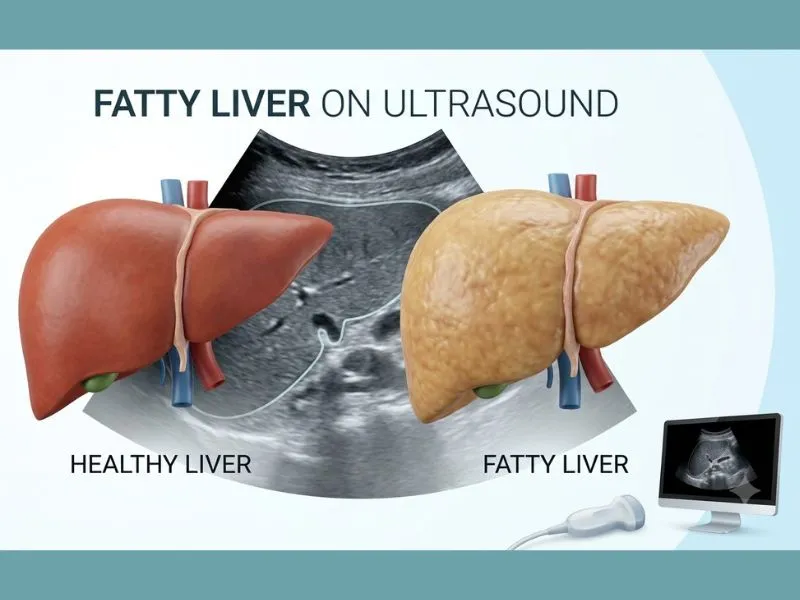
When an ultrasound suggests fatty liver, the liver may appear brighter than usual on the scan.
This happens because the ultrasound waves interact differently with a liver containing more fat.
An ultrasound can help detect fat in the liver, but it cannot by itself tell whether the liver has inflammation or how much fibrosis (scarring) is present.
So, a report saying “fatty liver” is an important finding, but it is not the complete picture of liver health.
Can Ultrasound Show the Severity of Fatty Liver?
Ultrasound can help identify liver fat, but its ability to accurately measure the amount of fat and determine the full severity of liver disease is limited.
More importantly, routine ultrasound cannot reliably determine whether there is liver inflammation or fibrosis.
That means someone with a fatty liver on ultrasound may need additional assessment depending on their risk factors and blood-test results.
What Are the Common Ultrasound Findings?
Depending on the scan and the radiologist’s report, you may see terms such as:
- Fatty liver
- Hepatic steatosis
- Increased liver echogenicity
- Bright liver
- Mild fatty changes
- Moderate fatty changes
- Severe fatty changes
These terms generally describe the appearance of fat in the liver on imaging.
However, the exact wording and grading can vary between ultrasound reports.
Does Fatty Liver on Ultrasound Mean Liver Damage?
Not always.
Fat accumulation and liver damage are not exactly the same thing.
Some people have fat in the liver with little or no inflammation or damage. In others, fatty liver can be associated with inflammation and progressive fibrosis.
This is why doctors may look beyond the ultrasound report and assess the risk of liver fibrosis.
Can You Have Fatty Liver With Normal SGPT?
Yes.
A person can have fatty liver even when SGPT/ALT is within the laboratory’s reference range. Normal liver enzymes do not completely rule out MASLD.
This is why a normal blood report should not automatically cancel out an ultrasound finding of fatty liver. Can Fatty Liver Have Normal SGPT? What You Should Know
What Tests May Be Needed After an Ultrasound?
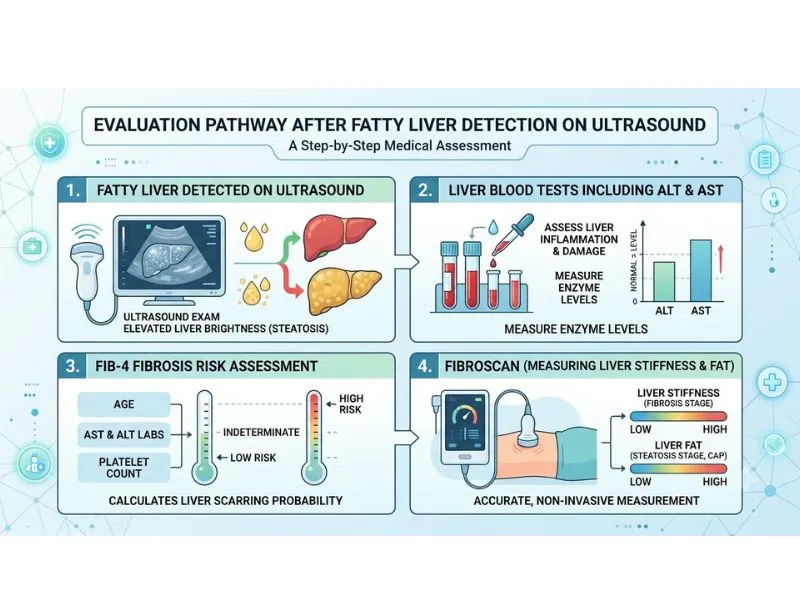
If fatty liver is seen on ultrasound, your doctor may decide whether additional evaluation is needed.
1. Liver Blood Tests
Blood tests may include ALT/SGPT, AST/SGOT and other liver-related tests.
These results can provide useful information, but they do not tell the entire story.
2. FIB-4 Score
The FIB-4 score uses routine blood-test information and age to estimate the likelihood of advanced liver fibrosis.
It is commonly used as an initial non-invasive fibrosis risk assessment.
3. FibroScan
FibroScan, also called vibration-controlled transient elastography (VCTE), can assess liver stiffness and can also provide a measure related to liver fat called the controlled attenuation parameter (CAP).Understand your FibroScan report: FibroScan Score Meaning: How to Understand Your Liver Stiffness Report
Is Fatty Liver on Ultrasound Reversible?
In many people, especially when fatty liver is identified early, lifestyle and management of metabolic risk factors can help reduce liver fat and improve overall liver health.
However, the appropriate approach depends on the underlying cause and whether inflammation or fibrosis is present.
If significant fibrosis or advanced liver disease is suspected, medical evaluation becomes especially important.
What Should You Do If Your Ultrasound Shows Fatty Liver?
Don’t panic, but don’t ignore the finding either.
A sensible next step is to discuss the report with your doctor and review:
- Liver blood tests
- Blood sugar and diabetes risk
- Cholesterol and triglycerides
- Weight and metabolic risk factors
- Alcohol intake
- FIB-4 or other fibrosis assessment when appropriate
- FibroScan or elastography when recommended
Doctors use medical history, blood tests, imaging, and sometimes additional testing to assess fatty liver and the risk of fibrosis
When Should You See a Liver Specialist?
Consider consulting a liver specialist if:
- Your ultrasound repeatedly shows fatty liver
- Liver enzymes remain abnormal
- You have diabetes or other metabolic risk factors
- Your doctor is concerned about fibrosis
- Your FIB-4 result suggests further assessment
- Your FibroScan shows increased liver stiffness
- You have other signs of chronic liver disease
A specialist can help determine whether the ultrasound finding represents simple liver fat or whether further evaluation is needed liver specialist.
Conclusion
Fatty liver on ultrasound means that the scan shows changes consistent with excess fat in the liver. It is an important finding, but it does not by itself tell you whether there is inflammation or liver scarring.
A normal SGPT/ALT does not necessarily rule out fatty liver. Depending on your risk factors and test results, your doctor may recommend blood tests, FIB-4, FibroScan or another form of liver assessment.
The good news is that finding fatty liver early gives you an opportunity to address the condition and protect your liver health.
For more information about fatty liver diagnosis, see the
NIDDK guide to fatty liver diagnosis.