

Patient Education & Diseases

All about liver donation

Hands holding a green ribbon symbol for liver donation awareness

What Is Liver Donation?

Liver donation allows a healthy person to donate a portion of their liver to someone who needs a transplant. Before donation, doctors assess the donor’s health, liver function, liver anatomy, and fitness for surgery.

Dr. Divakar Jain and his medical team provide specialized care for liver transplant patients and evaluate potential donors. They carefully assess each donor to help protect the health and safety of both the donor and the recipient.

Who can donate liver?

For a deceased donor liver transplant, the family of a person declared brain-dead can contact the hospital to discuss organ donation. The medical team assesses the organs to determine whether they are suitable for transplantation. Doctors allocate the donated liver according to medical needs and transplant compatibility.

For a living donor liver transplant, the donor must meet specific medical and safety criteria. The donor and recipient should have a compatible blood group. Ideally, the donor is a family member.

A living donor must be at least 18 years old. The acceptable upper age limit may vary, often around 50–60 years, depending on the transplant centre’s criteria. Before surgery, doctors assess the donor’s liver function, liver fat, anatomy, and liver volume.

The medical team also evaluates the donor’s physical and psychological fitness. These assessments help determine whether donation is appropriate and whether enough healthy liver tissue will remain for the donor’s recovery.

Blood group compatibility chart for liver transplant 

                                                                   Blood group compatibility chart for liver transplant

Evaluation of a Liver Donor

The medical team carefully evaluates each liver donor before surgery. This process includes blood tests, imaging studies, and assessments to determine whether the donor is fit for surgery.

Blood tests may include blood group testing, liver function tests, a complete blood count, viral markers, thyroid function tests, and a lipid profile. Doctors may also recommend other tests based on the donor’s health.

In addition, imaging studies may include a chest X-ray, CT scan, or MRI. The medical team also assesses the donor’s heart and lung function. Female donors may need a gynecological assessment, while psychological evaluation helps determine their readiness for donation.


Donor surgery

The surgical teams perform the donor and recipient surgeries simultaneously. Surgeons usually remove the right lobe (60–70% of the liver) or left lobe (30–40% of the liver) and implant it in the recipient.

After donation, the donor’s remaining liver portion usually regenerates and reaches its normal size within 2–3 months. Smaller portions of liver may be required for pediatric recipients.

The surgery generally takes 5-7 hours to complete. Doctors monitor the donor in the ICU for 2–3 days after surgery. Then, they transfer the donor to a hospital room.The total hospital stay is approximately 5-7 days.

Donor safety

The liver has a remarkable ability to regenerate. This means that the remaining liver tissue can grow after a portion of the liver is removed. This natural ability makes living donor liver transplantation possible. However, doctors carefully assess each donor to ensure that the remaining liver volume is sufficient for safe recovery.

How Does the Liver Regenerate?

Liver has a peculiar ability to regenerate. The Greeks knew about it. According to the Greek mythology, Prometheus was punished by Zeus by being chained. Zeus’ eagle used to come and eat a part of Prometheus’ liver. The liver regenerated till being eaten again by the eagle. It is because of this regenerative ability of liver, living donor liver transplantation is possible and safe.

Prometheus’ liver being eaten by Zeus’ eagle
 

How Much Liver Can Be Safely Removed?

Doctors call the part of the liver that remains after donation the remnant liver. Doctors carefully calculate the remnant liver volume before surgery. The required volume depends on the donor’s liver health and individual condition. If too little liver tissue remains, the donor may face a risk of serious complications, including liver failure.

How much liver is donated?

How Much Liver Is Donated?

Doctors calculate the amount of liver needed for donation using the graft-recipient weight ratio (GRWR). This ratio compares the weight of the donated liver portion with the recipient’s body weight.

Before surgery, the medical team uses CT imaging and specialized software to assess both the graft volume and the remnant liver volume. Based on these results, surgeons select a liver portion that supports the donor’s safety and meets the recipient’s medical needs.

For adult recipients, surgeons may use the right or left lobe, depending on the individual case. In pediatric cases, they may use a smaller portion of the liver.

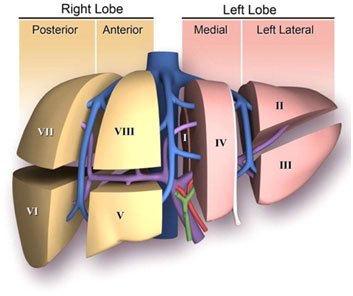
The right lobe of liver forms approximately 60-70% of the whole liver while the remaining 30-40% is contributed by the left lobe. Usually, the right lobe is taken for donation for adult recipient, while the left lobe or smaller than that (left lateral section, segment 2 or segment 3) is taken for a pediatric patient.

Segmental Anatomy of liver

Possible Complications After Donor Surgery

Liver donation is a major surgery, so complications can occur even after careful evaluation. Possible complications include bleeding, infection, bile leakage, and hernia formation. In rare cases, serious complications may occur. The medical team monitors donors closely and provides treatment if complications develop.

Long-term outcomes and quality of life after donor surgery

After donation, the remaining liver gradually regenerates. Recovery time varies from person to person. Donors need regular follow-up after surgery. In addition, they should follow medical advice. After recovery, they can gradually return to daily activities.

After medical clearance, many donors can gradually return to their daily activities, exercise, and work. Female donors may also be able to have a normal pregnancy, depending on their health and medical advice

Long-term care depends on each donor’s condition. Regular follow-up helps doctors monitor recovery and address any concerns.